Updated: March 5, 2026
Euclid is committed to achieving and maintaining the trust of our customers. As part of this commitment, we provide a robust security and privacy program that carefully considers data protection matters for clients that we host as part of the ClearVantage Sapphire hosting services.. This commitment to security and privacy extends to the data submitted by customers to our services (“Customer Data”).
Please note that MemberConnection, Euclid's SaaS offering for small associations and nonprofits, is hosted on the ClearVantage Sapphire architecture and all terms below are applicable to MemberConnection..
Services Covered
This documentation describes the architecture of, the security- and privacy-related audits and certifications received for, and the administrative, technical and physical controls applicable to ClearVantage Sapphire Hosting (Covered Services).
Some of the elements described in this documentation, such as log retention, back-ups, disaster recovery and return and deletion of data, do not apply to the temporary training and testing environments that Euclid may set up from time to time for its customers.
Architecture and Data Segregation
The Covered Services are operated in a multitenant architecture that is designed to segregate and restrict Customer Data access based on business needs. The architecture provides an effective logical separation of data (and in some cases a physical separation of data) for different customers via customer-specific "database identifiers" and allows the use of customer and user role-based access privileges.
Additional data segregation is ensured by supporting separate environments for testing and production.
The underlying infrastructure for which Customer Data is stored is a private cloud managed by Euclid and its sub processors, Rackspace and Alert Logic.
Certifications and Audits
- Payment Card Industry (PCI): The ClearVantage Payment Application Secure Service (CV-PASS), which performs all credit-card processing for the Covered Services, is validated annually by the PCI Council to meet PCI Secure Software Standard which can also be referred as PCI Software Security Framework (PCI SSF). Auditing, testing and validation of CV-PASS is performed by a third-party agent from a Qualified Security Assessor that is certified by The Payment Card Industry Security Standards Council. Euclid’s PCI SSF compliance can be viewed on the PCI Council website at https://listings.pcisecuritystandards.org/assessors_and_solutions/payment_software?agree=true.
- For the Covered Services, Euclid has a signed Attestation of Compliance (“AoC”) demonstrating Level 1 compliance as a Service Provider with the Payment Card Industry Data Security Standard ("PCI DSS"), as formulated by The Payment Card Industry Security Standards Council. Euclid’s signed Attestation of Compliance is available to clients upon request.
- Hosting Facility Service Organization Control (SOC) reports: The information security control environment for Euclid’s hosting facility undergoes an independent evaluation in the form of SOC 1 (SSAE 18 / ISAE 3402), SOC 2 and SOC 3 audits. The SOC 1 (SSAE 18 / ISAE 3402), SOC 2 and SOC 3 reports for Euclid’s hosting facility are available to Euclid clients upon request.
Additionally, the Covered Services undergo security assessments by internal personnel and third parties, which include infrastructure vulnerability assessments and application security assessments, on at least an annual basis.
Security Logs
All systems used in the provision of the Covered Services, including firewalls, routers, network switches and operating systems, log information to their respective system log facility or a centralized syslog server (for network systems) in order to enable security reviews and analysis.
Incident Management
Euclid maintains security incident management policies and procedures. Euclid notifies impacted customers without undue delay of any unauthorized disclosure of their respective Customer Data by Euclid or its agents of which Euclid becomes aware to the extent permitted by law.
Customer Password Policies
The Covered Services utilize the following password policies to enhance security:
- Customer passwords are stored using a one-way 256-bit salted hash.
- There is no way for Euclid personnel to recover customer passwords.
- The Covered Services support strong password policies, including setting requirements for a minimum length, the use of upper and lower case characters, the use of special characters, required changing after a set period of time, and automatic lockout after a specified number of failed login attempts.
- Automated password recovery by customers is done via a password reset request which emails a link to the user's email of record and when clicked prompts the user to create a new password that conforms to the password policies. The reset link is only valid for a Customer-defined period.
- Euclid personnel will not set a defined password for a user. Passwords are reset to a random value which must be changed on first use.
Physical Security
The Production data center used to provide the Covered Services has access control systems that permit only authorized personnel to have access to secure areas. Access is controlled through biometric authentication, keycards, and 24x7x365 surveillance. The facilities are designed to withstand adverse weather and other reasonably predictable natural conditions, utilize redundant electrical and telecommunications systems, employ environmental systems that monitor temperature, humidity and other environmental conditions, and contain strategically placed heat, smoke and fire detection and suppression systems. In the event of a power failure, uninterruptible power supply and continuous power supply solutions are used to provide power while transferring systems to on-site back-up generators. The on-site, always-fueled diesel back-up generators can operate the production data center for up to 90 days in the event of a complete regional power outage.
Reliability and Backup
All networking components, cooling systems, power systems, and data servers are configured in a redundant configuration. All Customer Data submitted to the Covered Services is stored on a primary database server configured for high availability. Customer Data is stored contemporaneously on redundant hard drives to ensure reliability and performance. Customer Data is backed up every four hours to physically separate storage devices located in the same data center, and all Customer Data is securely backed up and sent to a separate secure data center on a nightly basis.
Disaster Recovery
Euclid has disaster recovery plans in place and tests them at least once per year. The scope of the disaster recovery exercise is to validate the ability to failover a production instance from a primary server to the secondary server utilizing developed operational and disaster recovery procedures and documentation.
The Covered Services’ disaster recovery plans currently have the following target recovery objectives: (a) restoration of the Covered Service (recovery time objective) within 12 hours after Euclid’s declaration of a disaster; and (b) maximum Customer Data loss (recovery point objective) of 4 hours. However, these targets exclude a disaster or multiple disasters causing the compromise of both data centers at the same time, and exclude development and testing environments.
Network
The Covered Service’s primary data center utilizes nine network backbone providers, allowing traffic to be shifted as needed. This configuration, co-developed with Cisco, guards against single points of failure at the shared network level.
Managed Firewall
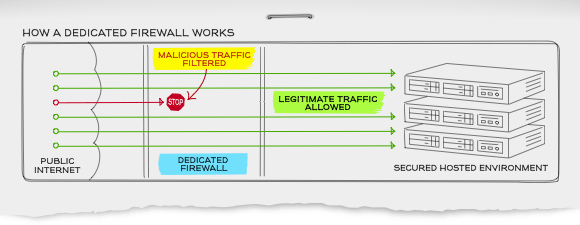
The Covered Services use actively managed firewalls to provide the highest level of security, earning ICSA Firewall and IPsec certification and Common Criteria EAL4 evaluation status. Working with Rackspace Security Engineers, Euclid has established general and specific rules to keep out unwanted traffic and ensure PCI-compliance.
Firewall rules have been established that only allows remote administrator level access from specific ip addresses. All remote file management is performed via secure FTP protocols and is only available to specific ip addresses or mac hardware addresses.
Intrusion Detection, Intrusion Prevention and Threat Management
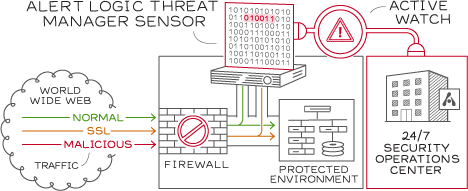
Euclid has partnered with Alert Logic to implement the Alert Logic Threat Management™ system that actively monitors all traffic coming into Euclid’s hosted environment. When an incident is detected, Alert Logic’s ActiveWatch service provides expert guidance from its security operations center (SOC), staffed around the clock by Alert Logic security analysts. Continuous integrated vulnerability scanning allows Alert Logic and Euclid to identify possible points of entry and correct them, and assists Euclid with meeting regulatory compliance requirements for the Covered Services.
File Integrity Monitoring
The Covered Services utilize Wazuh FIM XDR and SIEM software to monitor and centrally log all system file changes. Alerts are distributed to Euclid personnel in real-time when an unscheduled file modification is performed.
Multi-Factor Authentication
Access to core components of the Covered Services, including data, web, and application servers, is available only to authorized Euclid personnel and requires the use of PCI-compliant multi-factor authentication.
Managed Anti-virus
The Covered Services utilize fully managed anti-virus solutions that provide proactive, sustained protection against viruses, worms, Trojans, spyware, and other malware for Windows servers. Features Behavioral Genotype Protection™ for zero-day protection by proactively identifying malicious code on file servers and deleting it before it executes or reaches endpoint computers.
Viruses
The Covered Services do not scan for viruses that could be included in attachments or other Customer Data uploaded into the Covered Services by a customer. Uploaded attachments, however, are not executed in the Covered Services and therefore will not damage or compromise the Covered Services by virtue of containing a virus.
Data Encryption
The Covered Services use industry-accepted encryption products to protect Customer Data and communications during transmissions between a customer's network and the Covered Services, including through Transport Layer Encryption (TLS) leveraging 2048-bit RSA server certificates. Additionally, all data, including Customer Data, is transmitted between data centers for backup purposes across a dedicated, encrypted link utilizing AES-256 encryption.
Return of Customer Data
Unless otherwise specified in an agreement between Euclid and Customer, within 30 days post contract termination, customers may request return of their respective Customer Data. Euclid shall provide such Customer Data via a downloadable file in comma separated value (.csv) format.
Deletion of Customer Data
After termination of all subscriptions associated with an environment, Customer Data submitted to the Covered Services is retained in inactive status within the Covered Services for 60 days, after which it is securely overwritten or deleted from production within 90 days, and from backups within 120 days. Physical media on which Customer Data is stored during the contract term is not removed from the data centers that Euclid uses to host Customer Data unless the media is at the end of its useful life or being deprovisioned, in which case the media is first sanitized before removal. This process is subject to applicable legal requirements.
Without limiting the ability for customers to request return of their Customer Data submitted to the Covered Services, Euclid reserves the right to reduce the number of days it retains such data after contract termination. Euclid will update this Euclid Security, Privacy and Architecture Documentation in the event of such a change.
Analytics
Euclid may track and analyze the usage of the Covered Services for purposes of security and helping Euclid improve both the Covered Services and the user experience in using the Covered Services. For example, we may use this information to understand and analyze trends or track which of our features are used most often to improve product functionality.
Euclid may share anonymous usage data with Euclid’s service providers for the purpose of helping Euclid in such tracking, analysis and improvements. Additionally, Euclid may share such anonymous usage data on an aggregate basis in the normal course of operating our business; for example, we may share information publicly to show trends about the general use of our services.